When Work Culture Becomes a Weapon Against Employees

Every organization talks about culture. Mission statements proudly proclaim values like integrity, collaboration, innovation, respect, and teamwork. They want employees to be hungry, humble, and wise. Recruiters promise supportive environments where employees can grow professionally and personally. Company websites often feature smiling faces, flexible workspaces, and slogans celebrating people as the organization’s greatest asset.
But what happens when workplace culture stops being a source of support and starts becoming a tool of control? What happens when “hungry” becomes an excuse for employees to work long past 40 hours?

A healthy workplace culture creates psychological safety, encourages accountability, and helps employees thrive. An unhealthy culture, however, can become one of the most powerful weapons an organization possesses—one that wounds not through obvious acts of hostility, but through subtle expectations, manipulation, fear, and social pressure.
The most dangerous workplace cultures rarely announce themselves. Instead, they disguise dysfunction as loyalty, dedication, or “just the way we do things here.”
The Invisible Weapon
Unlike harassment or discrimination, toxic work culture often hides behind positive language.
Employees may hear phrases such as:
● “We’re a family.”
● “We all pitch in.”
● “This is just part of being committed.”
● “If you really cared, you’d stay late.”
● “Successful people sacrifice.”
On the surface, these statements sound harmless—even inspirational. Over time, however, they can become mechanisms for guilt, compliance, and emotional manipulation.
When saying “no” feels like betrayal, culture has stopped serving employees and begun controlling them.
Loyalty Should Never Require Self-Abandonment
Healthy organizations value loyalty, but they don’t demand unquestioning obedience.
Unfortunately, some workplaces confuse loyalty with silence.
Employees who ask questions become “negative.”
Those who set boundaries are labeled “not team players.”
Those who desire work-life balance are not “hungry.”
Workers who advocate for themselves are accused of lacking commitment.
Eventually, people stop speaking up altogether. Innovation declines. Honest feedback disappears. Problems remain hidden because employees learn that protecting leadership is more important than telling the truth. Good and hard-working employees quit while toxic leaders are celebrated and promoted. A culture that punishes honesty eventually loses the very trust it claims to value.
Burnout Is Not a Badge of Honor
Many workplaces unintentionally glorify exhaustion.
The first one in the office.
The last one to leave.
The employee answering emails at midnight.
The person who never uses vacation time.
These behaviors are often celebrated as evidence of dedication. In reality, they may be warning signs of an unhealthy environment. Burnout doesn’t produce better employees.
It produces overwhelmed employees.
Chronic stress affects concentration, creativity, decision-making, emotional regulation, physical health, and relationships outside of work. When organizations consistently reward overwork instead of sustainable performance, they communicate a dangerous message:
Your value is measured by your exhaustion. No employee should have to sacrifice their health to prove their worth.
Psychological Safety Matters
One of the strongest indicators of a healthy workplace is psychological safety.
Employees should be able to:
Ask questions.
Admit mistakes.
Offer new ideas.
Disagree respectfully.
Report concerns.
Seek help.
Without fear of humiliation or retaliation.
When people fear punishment more than they trust leadership, silence becomes the norm.
Mistakes multiply because no one feels safe discussing them. Problems grow because everyone assumes someone else will handle them. Innovation stalls because creativity requires vulnerability. Fear may produce compliance, but it never produces excellence.
Gaslighting in the Workplace
One of the more subtle weapons used within toxic cultures is workplace gaslighting.
Employees may hear things like:
“You’re too sensitive.”
“That never happened.”
“Everyone else seems fine.”
“You’re overreacting.”
“We never said that.”
Over time, employees begin questioning their own perceptions. Instead of recognizing unhealthy behavior, they assume they are the problem. Confidence erodes. Self-doubt grows.
Eventually, many capable professionals lose trust in their own judgment.
Healthy leaders seek clarity.
Unhealthy leaders rewrite reality.
The Cost of Forced Positivity
Optimism has value. Forced positivity does not. Some organizations discourage any conversation about problems under the guise of maintaining morale. Employees are expected to smile through impossible workloads. Concerns are dismissed as complaining. Legitimate frustrations become labeled as negativity. But refusing to acknowledge problems doesn’t eliminate them. It simply isolates the people experiencing them.
Real optimism isn’t pretending everything is fine. It’s believing improvement is possible while honestly confronting what’s broken.
When Boundaries Become Career Risks
One of the clearest warning signs of a weaponized culture is when healthy boundaries become professional liabilities. Employees who decline extra work are overlooked for promotions. Those who use earned vacation time are viewed as less committed. Parents who prioritize family are considered less ambitious. Workers managing health concerns feel pressured to hide them.
The message becomes unmistakable: Your personal life matters only when it doesn’t interfere with the organization’s expectations.
Healthy workplaces recognize that employees have identities beyond their job titles. Respecting boundaries doesn’t weaken organizations. It strengthens them.
Leadership Sets the Tone
Culture isn’t created by posters hanging in conference rooms. It is created by daily leadership decisions. Employees watch what leaders reward. What they ignore. What they tolerate. What they celebrate.
A company can publish beautiful values while rewarding toxic behaviors every day.
When high performers bully coworkers without consequences…
When managers are promoted despite abusive leadership…
When concerns disappear into silence…
Employees quickly learn the organization’s real values.
Culture is revealed by behavior—not branding.
The Human Cost
Behind every toxic culture are real people. Employees who lose sleep. Parents who miss family milestones. Professionals who begin doubting years of competence. Individuals who experience anxiety before work every morning. Talented workers who quietly leave because staying became emotionally unsustainable.
The financial costs of turnover, absenteeism, and burnout are significant. The emotional costs are immeasurable. No paycheck can fully compensate for prolonged damage to mental health, confidence, or personal relationships.
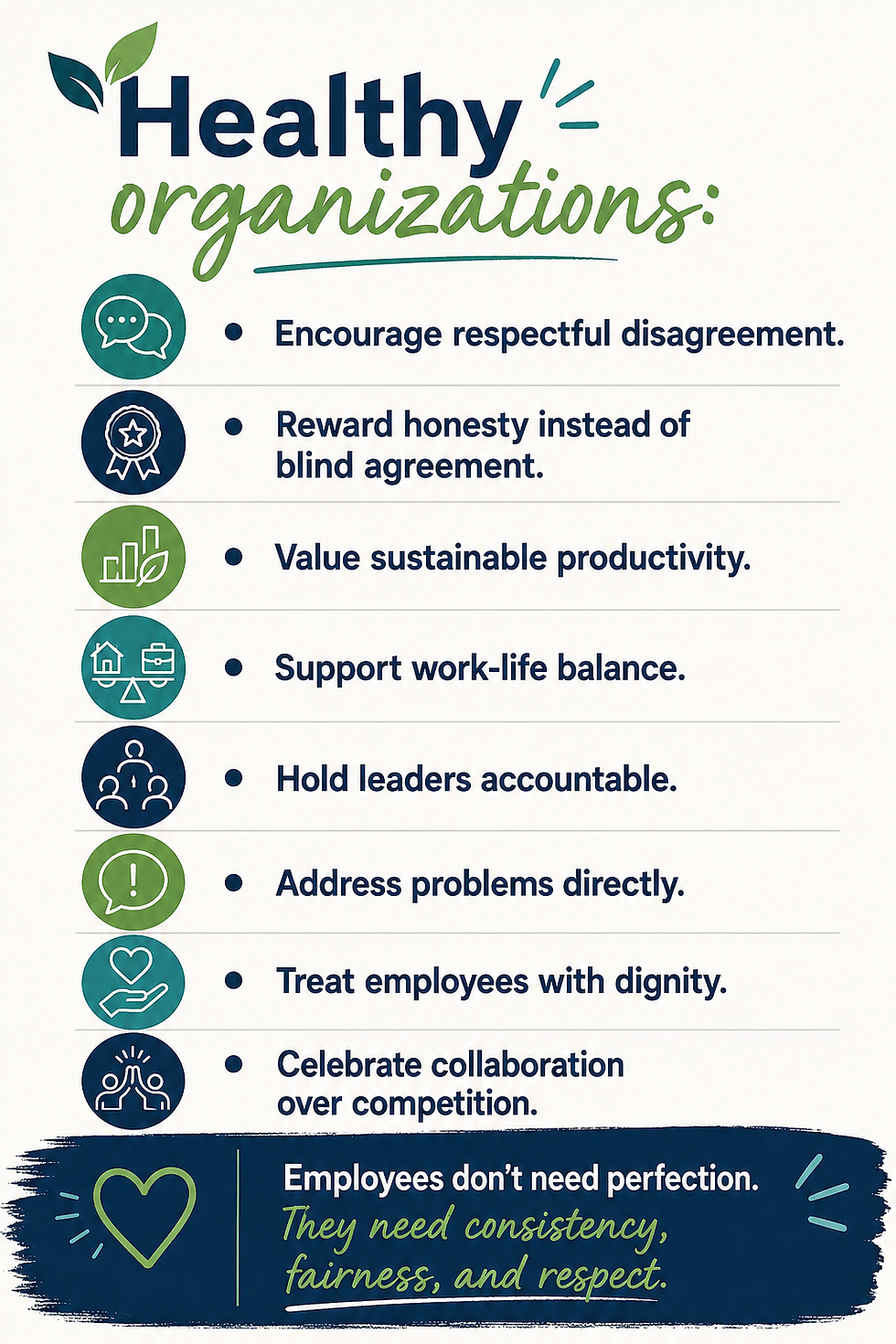
What Healthy Workplace Culture Looks Like
Healthy cultures aren’t perfect. Conflict still exists. Mistakes still happen. Deadlines still create pressure. The difference lies in how people are treated.
For Employees: Recognizing the Signs
If you constantly feel anxious before work…
If you apologize for setting reasonable boundaries…
If you’re afraid to speak honestly…
If you’re expected to be available at all hours…
If your concerns are routinely dismissed…
If success always requires sacrificing your well-being…
Pause and evaluate the environment. Not every difficult workplace is toxic. But no healthy workplace should require you to abandon your values, your health, or your humanity.
For Leaders: Culture Is Your Responsibility
Leaders often underestimate the influence of their everyday actions. Employees notice whether managers listen. Whether promises are kept. Whether accountability applies equally. Whether kindness is practiced under pressure. Whether people are treated with respect when mistakes occur.
Culture isn’t built during annual retreats. It isn’t built with free snack and sodas in the breaktoom. It’s built in ordinary conversations. In difficult meetings. In moments of conflict. In decisions made when no one is watching.
Leadership is not measured by authority.
It is measured by the environment leaders create for others.
Final Thoughts
A healthy workplace should challenge employees to grow—not require them to shrink themselves to survive. Organizations thrive when people feel valued, heard, respected, and psychologically safe. They suffer when fear, guilt, manipulation, or unrealistic expectations become accepted as “company culture.”
Every employee deserves to work in an environment where excellence is encouraged without sacrificing well-being, where accountability exists alongside compassion, and where success is measured not only by profits but by the way people are treated.
Culture is one of the most powerful forces in any organization. Used wisely, it inspires people to do their best work. Used carelessly, it becomes a weapon that slowly erodes trust, confidence, and human dignity.
The question every organization should continually ask is not, “What does our culture say?” It is, “What does our culture do to the people who live in it every day?”


Comments